
ESOL Entry 3 Speaking Practice
Build confidence with Entry 3 English speaking practice, everyday conversations, discussions, role plays and exam preparation.
Role Play: Looking For A New Job
Role Play: Checking Into A Hotel
Speaking & Listening Exam Guide
Role Play: Decorating A New Home
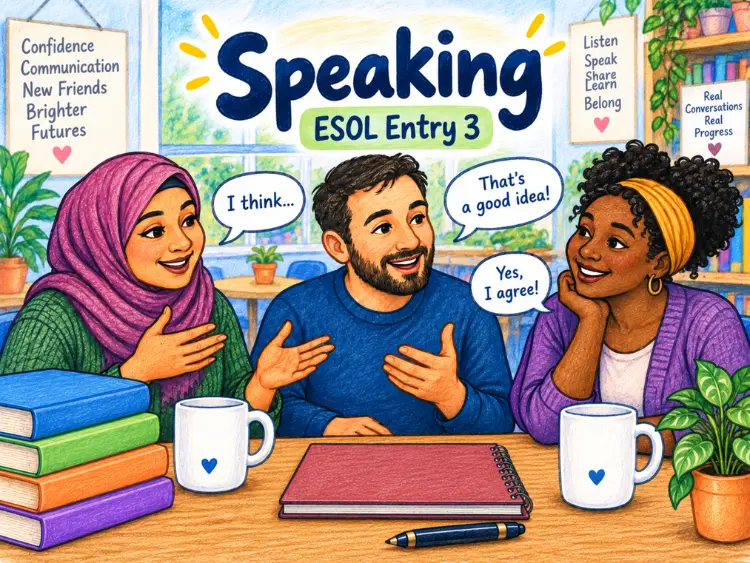
Entry 3 speaking practice
These speaking activities help learners communicate clearly in everyday, workplace and assessment situations. Use the videos and activities above to develop confident conversations, discussions, role plays and short presentations.
How to use Entry 3 speaking activities
Watch one example and note how the speakers ask questions, respond politely, explain ideas and keep the conversation moving. Practise the useful phrases aloud, then repeat the task with a partner using your own information rather than memorising every sentence.
Record a short answer on your phone and listen for clear pronunciation, complete sentences and an appropriate speaking speed. Try the task again after making one or two improvements. This helps you notice progress and become more comfortable speaking without a script.
Prepare for Entry 3 speaking assessments
In discussions, listen carefully and respond to what other people say. Give reasons and examples, ask follow-up questions and invite others to contribute. In role plays, stay in character, exchange the required information and agree on a clear outcome or plan.
Use the ESOL Entry 3 course page to combine speaking with listening, reading and writing practice. Learners preparing for an ESOL Skills for Life assessment can also consult the official ESB Entry 3 resources for additional guidance and resources.
Practise regularly in short sessions. Everyday opportunities such as making an appointment, asking for information or explaining a problem can all become useful speaking practice. Focus on being clear and interactive rather than trying to use unnecessarily difficult language.
Build a small bank of phrases for agreeing, disagreeing, clarifying and asking someone to repeat. Using these naturally will help you participate confidently when a discussion changes direction or you do not understand something immediately.
Before each activity, choose two communication goals, such as asking an open question and giving a clear reason. After the activity, reflect on whether you achieved them. Practising one small improvement at a time makes progress easier to notice and helps learners develop natural interaction rather than memorised answers.
Try practising with several different partners because each conversation will develop in a different way. One partner may ask for clarification, while another may introduce a new idea or disagree politely. Responding to these changes builds stronger communication skills. Tutors and independent learners can also create short role-play cards based on appointments, shopping, work, housing or local services, then swap roles and repeat the conversation with new details.